According to recent studies, the reptile fauna of Kopaonik National Park is of moderate diversity. Detailed research in recent years has confirmed the presence of 12 reptile species. A key characteristic of reptiles is their sensitivity to habitat changes, and monitoring their populations can quantify the negative impact of human activity on nature. The main threats to these species include habitat loss and fragmentation, pollution, and excessive human disturbance. Strictly protected reptile species in Serbia, recorded in Kopaonik National Park, include the European pond turtle (Emys orbicularis), grass snake (Natrix natrix), Aesculapian snake (Zamenis longissimus), smooth snake (Coronella austriaca), common European adder (Vipera berus), European snake-eyed lizard (Ablepharus kitaibelii), and viviparous lizard (Zootoca vivipara). Among the protected species, the nose-horned viper (Vipera ammodytes) has been recorded. The park is also home to the slow worm (Anguis fragilis), sand lizard (Lacerta agilis), green lizard (Lacerta viridis), and common wall lizard (Podarcis muralis).
Nose-horned viper (Vipera ammodytes)
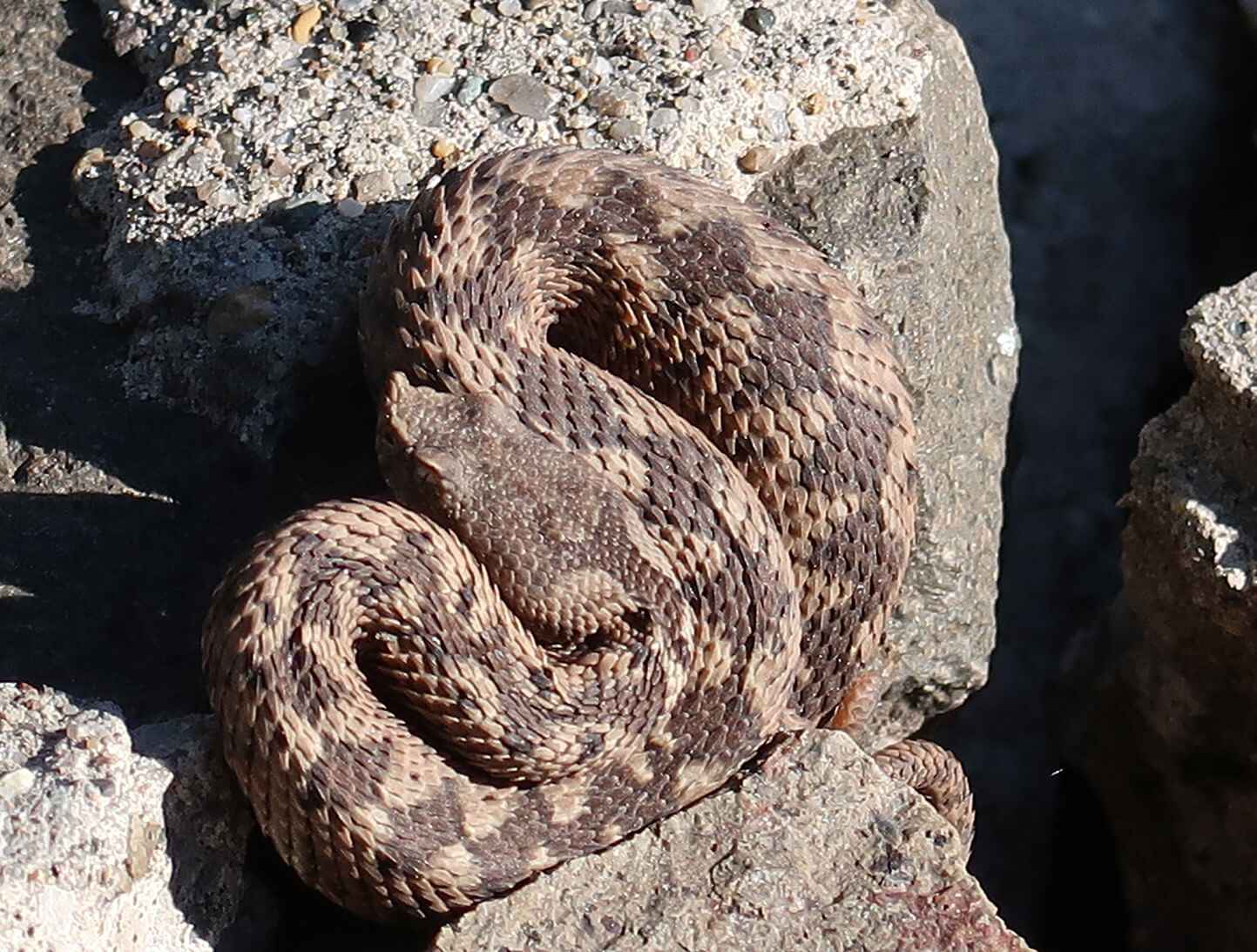
The majority of the range of the nose-horned viper (Vipera ammodytes) is located on the Balkan Peninsula, but it can also be found in northeastern Italy, southern Austria, northeastern Anatolia, and the Caucasus. In Serbia, it is widely distributed in the hilly and mountainous regions south of the Sava and Danube rivers. It predominantly inhabits xerothermic habitats—sub-Mediterranean oak forests, mosaic meadows, scrublands, and open habitats such as rocky terrains, screes, cliffs, and steep slopes. It typically grows up to 65 cm in length but can exceptionally reach up to 90 cm. The body is stocky, with a short tail and a triangular head distinctly separated from the trunk. The most striking characteristic of this species is a small horn at the tip of the snout. The dorsal side of the head is covered with small scales, and the scales on the body feature pronounced keels. In males, the base color is usually gray or gray-green with a dark brown or black dorsal zigzag pattern (which may consist of connected or separated rhomboids), while females are typically brown or reddish, less frequently yellowish or pinkish, with a less prominent brown dorsal pattern.

The common European adder (Vipera berus)
The common European adder (Vipera berus) is one of the most widely distributed reptiles, ranging from France and Great Britain in the west, across Siberia to Sakhalin Island in the far east of Asia, and from the Arctic Circle in the north to northern Italy, Albania, Greece, the European part of Turkey, Mongolia, northwestern China, and Korea in the south. In Serbia, the distribution of Vipera berus is highly disjunct, with geographically isolated populations. Lowland and hilly populations inhabit forest and forest-steppe areas or relict wet forests, while high mountain populations are characteristic of subalpine meadows and bogs or the edges of coniferous forests. The species can reach up to 90 cm in body length, although in the southern parts of its range it typically does not exceed 65 cm. The body is stout, the head is flattened, oval, clearly distinct from the body, and covered with large scales on the top. The eyes are relatively small, with a vertical pupil. The adder’s most distinctive feature is the dark zig-zag pattern running along its back, which can be continuous or interrupted. Sexual dimorphism in coloration is evident, with males exhibiting a pale or grey base color with a black dorsal pattern, while females are typically brown or reddish with a darker brown pattern. Melanistic (entirely black) individuals are also common in certain populations and can constitute a significant proportion of the group.

The viviparous lizard
Species description
The body length is approximately 6.5 cm from the tip of the snout to the cloaca. The tail is up to twice the length of the body, although it is often partially or completely lost. The limbs are short, the head is rather rounded, the neck is narrow, and the tail is thicker. Males have slimmer bodies compared to females. They have 25-37 scales on the back and 5-15 femoral pores on the thighs (usually fewer than 13, which distinguishes them from the wall lizard). The coloration and pattern of this species are variable. The main color is typically brown, but it can also be gray, olive-brown, or black. Females may have dark stripes along the sides and down the middle of the back. Sometimes females have light blue stripes or dark and light spots along the sides of the back. Most males and some females have dark spots on the ventral side. Males possess brightly colored ventral surfaces, usually yellow or orange, but rarely red.
Habitat
This species has been recorded in a wide range of habitats, including grasslands, meadows, wet scrubland, hedgerows, and forests. It is also found at peat bog edges, stream margins, coastal areas (marine cliffs and sandy dunes), and rural gardens.
Life cycle
Breeding occurs in April and May. Males grasp females by the jaws before mating—if the female is not interested, she will bite the male strongly. The offspring develop within the female for about three months. The species name reflects its ability to give birth to live young (adapted to cold climates), though some southern populations are oviparous (lay eggs). Three to ten young (or eggs) are usually born in July. The newborns are blackish and about 3 cm in length, initially encased in a membrane from which they emerge after one day. Males reach sexual maturity at two years of age, while females mature at three years. Zootoca vivipara develops placentas to facilitate pregnancy, but there is no significant nutrient transfer as seen in some other viviparous reptiles. Due to the cold climate, northern populations begin hibernation in September or October, either underground or in logs, and end hibernation around mid-March. Further south, the species is active throughout the year. It is listed on the IUCN Red List of Threatened Species. Locally, it is threatened by habitat loss due to intensified agriculture, urbanization, and tourist development.


Sand lizard (Lacerta agilis)
It inhabits most of Europe except for large parts of the Iberian and Apennine Peninsulas, southern France, European Turkey, and much of Greece, as well as Central Asia up to Mongolia. In Serbia, it has a disjunct distribution—common in Vojvodina south of the Sava and Danube Rivers and found only in hilly and mountainous areas at elevations greater than 600 meters. It primarily occupies habitats with dry, porous soil covered with low vegetation such as meadows, steppes, scrublands, sandy areas, and high mountain pastures. This lizard grows up to 9 cm from the snout to the cloacal opening, with the tail approximately 1.3 to 1.7 times the length of the body. The body is robust and stocky, with a short, blunt head and short legs. The basic body color is green in males and gray or gray-brown with a yellow belly in females. Both sexes have a complex dorsal pattern consisting of a series of darker and lighter spots with a broken light line running down the middle of the back. Dark spots, blotches, or ocelli are present on the sides.